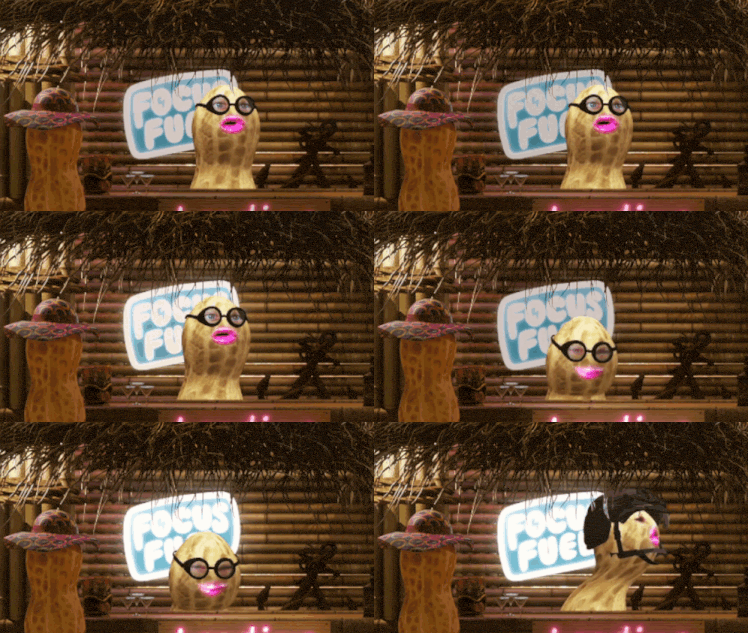
A peculiar cast of characters has begun to dominate the digital stage: a grinning neon raccoon dispensing life advice at 2 a.m.; a melancholy, anime-styled moth who sings lullabies to millions; and most recently, ‘The Burnt Peanut’ an absurdist floating avatar whose deadpan humour and glitchy charm have propelled it from obscurity to global meme status. None of these performers have faces. None reveal their names. And yet each commands vast audiences, forging emotional connections with followers who may never know or even care who sits behind the screen. This is not a fringe curiosity. It is the clearest sign yet that we have entered the ‘Avatar Age’.
In the past five years, VTubers and virtual performers have exploded from a niche Japanese subculture into a global entertainment economy worth an estimated US$1.7 billion in 2023 and with fanbases rivalling those of conventional celebrities. Agencies like ‘Hololive’ and ‘Nijisanji’ now manage rosters of performers who appear not as themselves but as meticulously crafted digital beings such as fox spirits, alien DJs, gothic librarians and cyber-samurai. Their concerts sell out arenas. Their merchandise drops crash servers. Their livestreams generate millions of dollars in donations annually. Yet the most revealing part of this movement is what it tells us about us. Avatars are not a rejection of humanity; they are an expression of it: a psychological, sociological, and technological breakthrough unfolding in real time.
The rise of entities like The Burnt Peanut, JellyCat-inspired puppet VTubers, faceless AI streamers and surreal “virtual comedians” signals a shift in what people seek from online identity. These avatars are often more relatable than traditional influencers precisely because they are not bound by physical form. They can be shy without being judged, expressive without being vulnerable, creative without being constrained. They bypass the biases of appearance, gender, race, age and body, granting their creators a space where the self can be performed without fear.
In a world where online harassment is endemic and the pressure to be visibly perfect has become its own form of modern labour, avatars offer a rare kind of refuge. They provide creators many of them young, anxious, marginalised, or simply exhausted by the demands of the algorithm, a way to show more of their personality by showing less of their physical self. Paradoxically, many find that behind an avatar, they feel more authentic than they do in real life. And audiences respond. They connect. They believe. They follow narratives, invest in characters, and develop parasocial relationships with entities that exist only as pixels and code. The old assumption that authenticity requires physical presence has collapsed; digital masks have become mirrors.
This phenomenon is more than entertainment. It is a cultural shift with profound implications for how we work, socialise, express ourselves and understand identity. It is also a precursor to the Web3 world we are rapidly moving toward, one where digital selves can be owned, traded, verified and carried across platforms; where representation becomes portable; and where our online personae may one day feel as consequential as our offline ones. We are standing at the threshold of a new identity frontier one where the self is fluid, expressive, and sovereign. Welcome to the Avatar Age. A world where the faces we choose may reveal more truth than the ones we are born with.
The Cultural Explosion: How VTubers Became a Global Entertainment Powerhouse
The rise of VTubers did not happen overnight. It began as a curious subculture in Japan in the early 2010s, where early pioneers like ‘Kizuna AI’ blended motion capture, voice acting, and anime aesthetics to create a new form of digital performance. What looked, at first, like a novelty experiment soon revealed itself to be a structural shift in entertainment. Viewers weren’t just watching a cartoon they were interacting with a living persona, performed in real time by a human who could remain safely hidden behind a digital veil.
From these beginnings emerged a global storm.
By 2020, major agencies such as ‘Hololive Production’ and ‘Nijisanji’ had transformed VTubing into a tightly organised entertainment industry. They built production pipelines, character design studios, training academies, talent management arms, and merchandising teams. Hololive’s roster alone has drawn billions of cumulative views, and its top performers can earn millions per year through livestream donations, sponsorships and brand partnerships. Some VTuber concerts now fill stadiums and generate viewing numbers that rival the world’s largest pop tours.
Asia may have lit the spark, but the flame spread fast. The rise of more surreal figures from the chaotic humour of The Burnt Peanut to Western avatars like CodeMiko, to hybrid digital puppets and AI-enhanced characters signalled something bigger: VTubing had outgrown its cultural roots. It had become a universal format, understood and embraced across continents.
Why did this happen? Because VTubing solves problems that traditional influencer culture created. In a world saturated with polished Instagram perfection, the VTuber format offered relief: no beauty standards, no need for carefully curated lifestyles, no intrusive surveillance of the private self. Creators could perform without sacrificing their privacy, and audiences could enjoy a form of entertainment built less on envy and more on imagination.
The numbers tell a stunning story. Between 2020 and 2023, VTuber video uploads grew by over 350%, and livestream watch-hours increased by more than 750%. Entire digital economies have grown around them: patreon-style memberships, fan-made art markets, avatar commissions, virtual concert tickets, and merchandise drops that regularly sell out within minutes. More importantly, VTubers have become cultural barometers. They are often the first to experiment with real-time motion capture, voice modulation, AI-enhanced performance tools and early metaverse platforms. They embrace the kinds of digital identities that many younger audiences increasingly see as natural rather than futuristic.
The Burnt Peanut phenomenon perfectly illustrates this cultural shift. It sits alongside a growing roster of digital entertainers from animated raccoons, ethereal AI singers, chaotic virtual blobs whose success is not a fluke but a sign: people crave connection that transcends physicality. They want characters who feel alive, unpredictable, unbound by real-world limitations. They want authenticity of spirit not appearance.
In essence, the VTuber boom is not about cartoons or novelty; it is about freedom. Freedom from judgement, from surveillance, from identity constraints, from the relentless demand to be visually marketable. It is entertainment reimagined for a generation that grew up both empowered and exhausted by digital life. And just as importantly, it is the prelude to a much larger transformation: a future where avatars are not just performers, but representations of ourselves, owned and controlled through Web3 infrastructure, portable across online worlds, as significant as any physical identity we hold now. We are not merely watching VTubers rise. We are watching the early architecture of a new social reality take shape.
The Psychology of Avatars: Why We Become More Ourselves When We Stop Being Ourselves
If VTubers represent the cultural front of the Avatar Age, psychology explains its emotional core. At first glance, it seems paradoxical: how can people feel more authentic when they are hiding behind a digital mask? Yet decades of research into identity, performance, and online behaviour suggest that this contradiction is entirely rational perhaps even inevitable.
The sociologist Erving Goffman, in his seminal 1956 work ‘The Presentation of Self in Everyday Life’, argued that human interaction is a kind of theatre. We perform versions of ourselves depending on context: polished in professional spaces, informal among friends, guarded with strangers. The self is not fixed; it is curated. In this sense, avatars do not distort identity; they reveal its architecture. They allow individuals to externalise parts of themselves that real-world social pressures might suppress.
Digital identity researchers have long observed this phenomenon. Psychologist Sherry Turkle in ‘Life on the Screen’ (1995), documented how online environments allow people to experiment with versions of themselves they cannot safely or confidently express offline. Turkle argued that digital personas can become “a laboratory for the construction of identity,” a statement that resonates even more strongly in the avatar-driven ecosystems of today.
The rise of VTubers and phenomena like The Burnt Peanut align closely with what behavioural economists call the “disinhibition effect” a concept articulated by psychologist John Suler. In his 2004 study on online behaviour, Suler found that anonymity and reduced physical cues can increase emotional honesty. When freed from the scrutiny of appearance, people communicate more openly. Avatars, then, do not simply shield us; they liberate us. This liberation is not merely emotional. It is cultural.
Through avatars, creators from marginalised communities (queer, neurodivergent, disabled, introverted) can participate in public life without facing the biases or stigma often tied to physical identity. Some VTubers openly discuss their mental health struggles, disabilities, or anxieties while behind their avatars. Studies by the Oxford Internet Institute (2022) show that individuals who rely on digital personae often experience reduced performance anxiety, increased confidence, and improved social engagement.
The Burnt Peanut phenomenon exemplifies how an avatar can become an anchor for shared emotion. Its absurdity creates distance from reality, offering viewers a safe conduit for humour, catharsis and belonging. People, especially young audiences, are not simply entertained they feel seen, in a way that traditional performative influencer culture rarely achieves.
There is also a deeper philosophical shift underway. As theorist Judith Butler famously argued, identity is not innate but performed. In this light, avatars are not distortions of self but extensions of selfhood, tools that allow individuals to express the fluidity of identity with a precision the physical world often prohibits. When someone says, “I feel more like myself as my avatar,” it is not fantasy; it is psychological truth.
But there is a social cost too. Some critics worry that the Avatar Age may amplify escapism or detach individuals from real-world responsibilities. Others fear a deepening of parasocial relationships, where followers connect more intensely with virtual personas than with real people. These concerns, backed by early findings from media psychology, demand attention.
Yet even sceptics acknowledge that avatars are not going away. Instead, we must understand why they resonate: people are seeking spaces where they can exist without compromise. The psychology of the Avatar Age is not about replacing the self; it is about reclaiming it. It is about choosing, rather than inheriting, the form through which we speak to the world. In that sense, avatars are not escapism. They are a new vocabulary for authenticity.
Avatars, Labour, and the New Creator Economy: How VTubing Rewrites the Rules of Work
If avatars are reshaping identity, they are also rewriting the very nature of labour in the digital age. The rise of VTubers and avatar-driven creators marks one of the most significant transformations in contemporary work, a shift as profound as the early influencer boom of the 2010s but with far larger implications for privacy, agency and economic autonomy.
Traditional influencer culture relies on the labour of visibility. Success depends on constant exposure, physical perfection, relentless self-branding, and an algorithmic treadmill that punishes rest. For many, the cost of participating in this economy is burnout, loss of privacy, and the commodification of one’s personal life. In contrast, the avatar economy offers a radically different model: the labour is performed by the persona, not the person.
This separation between worker and public-facing identity is unprecedented in modern media, and it answers a question that scholars such as Richard Sennett raised decades ago in The Corrosion of Character (1998): How can individuals thrive in an economy that demands endless self-exposure? VTubers provide one compelling answer: by creating a buffer between the self and the spectacle. Behind an avatar, creators can protect their private lives, control their availability, and maintain boundaries without sacrificing engagement.
The economic implications are striking. VTubers sit at the intersection of entertainment, gaming, live streaming, and digital art, generating revenue through donations, sponsorships, memberships, merchandise, digital concerts, and even NFT-backed assets. A 2023 report from StreamElements shows that the top ten VTubers collectively earned more from livestream donations than the top ten traditional streamers on major platforms. This is not a niche labour market; it is the early formation of a new creator–avatar economy.
For many creators, especially women and marginalised groups who face disproportionate harassment online, VTubing is not just a creative choice but a workplace safety solution. Studies from the Pew Research Center (2021) indicate that 41% of women in digital content roles experience severe online harassment. Avatars reduce this risk dramatically, allowing creators to focus on craft rather than defence.
The Burnt Peanut and similar viral phenomena demonstrate another essential insight: the avatar can become an asset, a brand, even a small intellectual property ecosystem. In a Web3-enabled future, creators may fully own their avatar identities through blockchain-based systems, ensuring that digital selves (their likeness, lore, and creative output) remain under their control. This echoes the vision of economists like Hernando de Soto, who argued that ownership structures are the foundation of economic empowerment. In the Avatar Age, ownership extends to the digital body itself.
This transformation also disrupts traditional labour hierarchies. Agencies that once managed real-world performers are reorganising around virtual talent, building design studios, lore-writing teams, animators, and technical engineers. Small creators can compete with industry giants simply by crafting a compelling avatar and narrative. The barriers to entry are fundamentally lower, and the economic reach is exponentially wider.
Yet this new labour infrastructure is not without ethical tension. Who owns the avatar if a creator leaves their agency? Should AI-augmented avatars count as labour or intellectual property? What rights should digital performers have when their bodies are lines of code?
These questions are not hypothetical. Japanese courts have already begun hearing disputes over avatar ownership, and Western legal scholars are drafting early frameworks for “persistent digital identity rights.” Work is no longer confined to the physical self, and the law is scrambling to catch up.
The VTuber revolution, then, is not simply entertainment evolution rather it is an early blueprint for future work. Avatars are showing us that labour can be safer, more creative, more sovereign, and less exploitative. They hint at a world where our economic contribution is defined not by our physical presence, but by our expressive potential and they force us to reconsider a core assumption of modern capitalism: What if the future worker is not a body, but a character?
The Web3 Dimension: Owning Your Digital Self in a Decentralised Future
If VTubers represent the cultural and psychological frontier of digital identity, then Web3 provides the political and economic architecture that will determine who controls that frontier – be it individuals, corporations, or something more decentralised. In many ways, the Avatar Age is converging with the Web3 era because both are driven by the same core desire: self-sovereignty in a world where identity has become increasingly digitised and increasingly vulnerable.
At the heart of this convergence lies a question theorists such as David J. Gunkel and Lawrence Lessig have grappled with: who owns the digital self? In the Web2 world, the answer is depressingly simple: platforms. Our data, our likeness, our creative output, and often the very avatars we embody belong not to us, but to the corporations that host them. This creates a foundational tension for VTubers and digital performers. Their identity feels like theirs, but legally, it is often something else.
Web3 is attempting to rewrite this power dynamic from the ground up. With blockchain-based identity systems, creators can own their avatar designs, character lore, voice models, performance history, and fan community assets in a way that is cryptographically secure and portable across platforms. Much like economist Elinor Ostrom’s work on common-pool resource governance, Web3 offers the possibility of an identity ecosystem that is neither purely corporate nor purely individual, but shared, verifiable, and self-governing.
This has immediate implications for VTubers and avatar creators. Consider a digital performer whose avatar becomes globally recognisable like The Burnt Peanut or the many AI-hybrid VTubers now emerging. In Web2, a platform or agency could claim ownership of the model; in Web3, the avatar can exist as a non-fungible, self-owned identity token, verifiable on-chain, transferable between studios, and incapable of being seized by a platform’s terms of service.
This shift does more than protect creators. It transforms avatars into enduring digital assets with provenance, value, and rights. Much like a musician owns their master recordings, digital performers can own the “master files” of their identity. Their digital body, in other words, finally belongs to them.
But the real revolution comes from interoperability – the ability for an avatar to travel between platforms, games, social spaces and virtual worlds without losing identity or functionality. This is where the next generation of Web3 protocols is directing its energy. Companies like Ready Player Me, as well as decentralised metaverse projects, are building frameworks where a digital identity can move seamlessly across environments. For creators and audiences alike, this represents a shift from platform captivity to identity freedom.
In this context, avatars become something closer to digital passports. They carry reputation scores, achievement histories, creative output, and even economic ownership. Philosopher Luciano Floridi, known for his work on the “onlife” concept, argued that the boundary between online and offline selves is dissolving. Web3 turns that dissolution into infrastructure.
There are risks, of course. A decentralised identity system can empower but it can also expose. A poorly secured digital wallet, a hacked private key, or a fraudulent smart contract could threaten the very self someone has spent years cultivating. And as ever, inequality can replicate itself in new forms: those who can afford premium avatar rigs or blockchain domain names may dominate early markets.
Yet the benefits remain transformative. Web3 allows creators to monetise without middlemen, manage communities through decentralised autonomous organisations (DAOs), and ensure that the value they generate returns to them, not to opaque corporate algorithms. Entire fandom ecosystems can run on shared tokens, giving fans actual ownership (not just engagement) in the cultural worlds they love. Most importantly, Web3 gives digital performers autonomy. Autonomy over identity, over income, over creative direction, over their place in the online world. In a future where avatars become our second skins, Web3 is the architecture that protects them.
The Social Consequences: Communities, Parasocial Bonds, and the New Digital Intimacy
If avatars reshape identity and Web3 secures it, then the social world built around them reveals what this transformation truly means for human connection. At the centre of the Avatar Age is a profound shift: people are forming real, durable, emotionally complex communities around beings who do not physically exist. And rather than diminishing our humanity, these relationships expose what we have always sought from one another namely recognition, belonging, and continuity.
Parasocial relationships, once discussed in the context of television hosts and pop stars, now take on a more intimate dimension. Media theorists Horton and Wohl, who coined the term in 1956, described how audiences can form one-sided bonds with performers who seem to speak directly to them. The VTuber era intensifies this effect not because audiences are more naïve, but because avatars are designed for closeness. Their digital faces maintain perfect eye contact, their voices adapt to emotional tone, and their worlds are constructed to simulate presence.
Yet something deeper is happening. Avatars allow people to join communities without the constraints of physical identity. A fan may connect with The Burnt Peanut’s absurd humour, a moth-themed VTuber’s emotional vulnerability, or a cyber-samurai’s gameplay intensity, and not because they know who performs them, but because the characters open a space of shared narrative. Sociologist Benedict Anderson’s idea of “imagined communities” finds a modern parallel here: people form nations of affinity around avatars, held together not by geography but by story, ritual, and belief.
These communities can be surprisingly healthy. Research from the University of Queensland (2022) found that online fandoms built around avatars often provide emotional support networks comparable to offline friendships. Because avatars attract people with similar interests, values, or emotional needs, they can cultivate environments that feel safer and more empathetic than mainstream social media.
But there are shadows too. The intimacy of VTuber communities can blur boundaries, especially when creators feel pressured to maintain constant presence. Avatars can be misinterpreted as always “on,” always accessible, always emotionally available. This dynamic can strain creators who are, behind the digital mask, still vulnerable humans. It can also create expectations among fans that drift into entitlement or emotional dependence.
The emergence of AI-assisted avatars complicates this further. What happens when fans form bonds with beings that are not human behind the screen? Early experiments with AI streamers show rising engagement, raising ethical questions similar to those posed by philosopher Donna Haraway in The Cyborg Manifesto: when machines become companions, where does responsibility lie? Who shapes the ethics of those interactions? And what happens when algorithms learn to simulate emotional reciprocity?
Despite these questions, the Avatar Age offers social opportunities worth embracing. Communities built around avatars often become creative ecosystems producing art, music, memes, fanfiction, collaborative projects, even charitable fundraising. Some have raised hundreds of thousands of dollars for disaster relief or social causes, demonstrating that virtual characters can mobilise real-world impact.
Moreover, avatars can reduce social barriers. Anxious, isolated, or neurodivergent individuals often find their first communities through VTuber fandoms. These digital spaces can act as testing grounds for confidence, connection and communication, a concept supported by psychologist Albert Bandura’s theories of self-efficacy. When people feel welcome in avatar-led communities, they may gain skills and social ease that carry back into offline life.
The Burnt Peanut phenomenon illustrates a new truth: digital intimacy is not inferior to physical intimacy. It is different. It is shaped by narrative, humour, imagination, and the peculiar closeness that arises when a person can project themselves safely through a fictional vessel.
The social consequences of the Avatar Age are neither dystopian nor utopian. They are human. They reflect our perennial need to belong, and our evolving ability to build belonging in new ways. Avatars may be made of pixels, but the emotions they evoke from loyalty, comfort, joy and curiosity are entirely real. In a fragmented world, these characters become anchors. Not substitutes for reality, but new forms of connection within it.
The Ethical Frontier: Risks, Regulation, and the Future of Digital Personhood
The Avatar Age does not merely entertain or empower, it challenges some of the most fundamental assumptions society holds about identity, labour, and accountability. As avatars become persistent, economically valuable, emotionally resonant, and legally consequential, the ethical terrain surrounding them grows increasingly complex. We are entering a world where digital personhood is no longer metaphorical but a genuine policy concern. At the core lies a deceptively simple question: Who is responsible for what an avatar does?
In traditional media, accountability is straightforward: the performer is the person on screen. But when that performer is concealed behind a digital shell, and the shell itself may be partially AI-driven, the line between creator, character and code begins to blur. Philosopher Hannah Arendt, in discussing the nature of action, warned that responsibility becomes muddled when the doer is obscured. Avatars test that boundary in real time.
Consider the legal disputes already emerging in Japan, South Korea, and the United States over avatar ownership. In several early cases, agencies claimed rights to an avatar even after a performer tried to leave, arguing that the digital persona was a piece of corporate intellectual property. Performers, meanwhile, argued that the avatar represented their labour, reputation, and identity.
Without clear legal frameworks, these disputes hint at what legal scholar Lawrence Solum once called the problem of “digital personhood”: when a virtual identity becomes economically active, socially embedded, and culturally recognisable, the law must treat it as something more than property but not quite as a human. Web3 complicates this further by enabling self-owned avatars, secured through NFTs or decentralised identifiers. In such cases, the avatar becomes neither corporate nor platform-bound, it becomes sovereign.
Yet sovereignty has consequences. What happens when an autonomous or semi-autonomous AI avatar defames someone? Or spreads misinformation? Or interacts with vulnerable users? Regulatory bodies from the EU to Singapore are beginning to ask these questions in the context of AI governance, but avatars introduce new wrinkles: these digital beings are not just tools; they are characters with audiences, communities, and cultural momentum.
There are also ethical concerns around manipulation and emotional influence. If a VTuber or AI avatar has a fanbase composed of young or emotionally fragile viewers, where does the duty of care lie? The parasocial bonds that give VTubing its warmth can also create asymmetrical power dynamics, ones not fully addressed by current platform policies. The literature on media psychology, from Horton and Wohl to contemporary scholars like Marwick and Baym, warns that parasocial intimacy can become exploitative when boundaries are unclear.
Then there is the question of identity fraud and impersonation. In Web3-enabled systems where avatars can be bought, sold, or licensed, the potential for misuse expands. Who ensures that a person’s avatar is not hijacked, deepfaked, or repurposed for malicious ends? When a digital identity becomes as significant as a passport, the mechanisms for protecting it must be equally robust. Zero-knowledge proofs, cryptographic identity locks and decentralised attestations may offer solutions, but they require widespread adoption and careful governance.
And yet, amidst this regulatory turbulence, avatars offer an extraordinary opportunity to rethink what fairness and autonomy look like online. They allow workers to avoid the biases associated with appearance, accent and disability. They allow users to explore identity safely. They open new economic paths for marginalised communities. The challenge is ensuring that these freedoms are not overshadowed by exploitation or inequity.
We are, in many ways, revisiting the questions that the early architects of the internet faced. As Tim Berners-Lee once said of the Web, “We must build it for everyone.” The same is now true for digital personhood. The frameworks we design today from legal, ethical and technological, will shape whether the Avatar Age becomes a tool of empowerment or enclosure.
One thing is clear: the stakes are high. Avatars are not going away; they are becoming more capable, more autonomous, and more woven into the fabric of human interaction. Regulation must evolve not to stifle creativity, but to protect dignity, ensure fairness, and safeguard the boundary between expression and exploitation.
The Avatar Age demands not only innovation but ethical imagination. It calls on policymakers, technologists, scholars, and communities to confront a truth: the digital beings we create are reflections of ourselves and our responsibilities to them mirror our responsibilities to one another.
The Avatar Age Has Already Begun
It is tempting to dismiss avatars as novelty – playful experiments in entertainment and identity. But that view no longer fits the world we are entering. Virtual performers now command global audiences, digital communities form around beings without bodies, and avatar identities accumulate economic, social and even legal significance. The Avatar Age is not theoretical. It is already woven into our cultural fabric.
Figures like The Burnt Peanut and countless other virtual personalities are more than digital curiosities; they are signals of a society reimagining what it means to present oneself, to connect with others, and to find a voice online. Avatars reveal our evolving psychological needs (desire for safety, creativity, self-expression, and belonging) at a time when the pressures of visibility and perfection have made traditional influencer culture unsustainable.
With Web3 reshaping digital ownership, the avatar is poised to become something even more consequential. Soon, our digital selves may be assets we truly control – portable across platforms, protected by cryptography, and capable of earning income or building communities independent of corporate oversight. This shift forces us to confront questions of accountability, intellectual property, emotional influence and digital personhood, all of which will shape the next decade of online life.
There will be challenges. There will be misuses and misjudgments. Yet the possibilities far outweigh the pitfalls. Avatars offer new ways to work, to belong, to express identity without fear, and to build culture across borders and bodies. They allow us to imagine ourselves not as fixed entities but as creative, evolving selves. The Avatar Age is not the future of technology; it is the future of human expression … and it has already begun.
By Pritish Beesooa
Head of Web3 Development