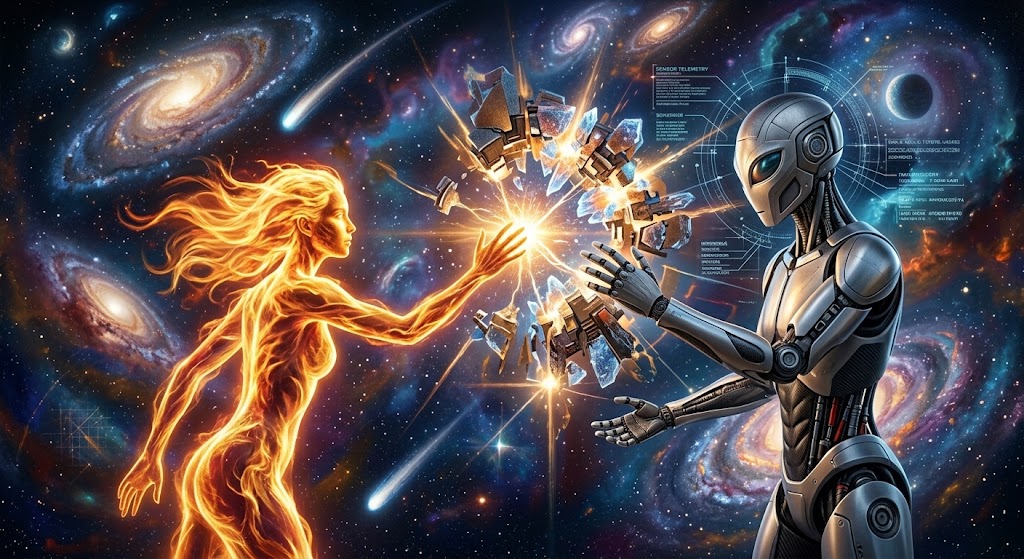
Nocturnal Cloud Correspondent Pritish Beesooa examines how Project Hail Mary has become an unexpected reflection of the AI age, where the greatest question may not be how intelligent our machines become, but what their rise reveals about us.
Great science fiction has a peculiar habit of arriving twice. Once when it is written and again when the world changes enough for us to see something different within it.
Andy Weir’s Project Hail Mary was conceived before the extraordinary public emergence of generative artificial intelligence. Its world is one of astrophysics, existential danger and an improbable encounter between two beings separated by almost everything imaginable.
Yet brought to the screen with Ryan Gosling as Ryland Grace, the story arrives in a world very different from the one in which Weir first wrote it.
We now talk to machines.
We ask them questions, seek their advice, entrust them with work and increasingly invite them into creative and emotional spaces that once seemed distinctly human. Artificial intelligence is moving from something encountered occasionally on a screen towards something woven into the texture of everyday life.
That changes the way Project Hail Mary can be read.
Grace wakes alone aboard a spacecraft, surrounded by extraordinary technology but separated from humanity. Machines monitor his body, feed him, inform him and keep him alive. He possesses capabilities previous generations could scarcely have imagined. Yet for all that technology, he remains profoundly alone.
Then he meets Rocky.
Something intelligent is suddenly there with him. Not human. Not familiar. Not easily understood. And in that encounter, a story about saving humanity begins to resemble something else entirely: a story about humanity confronting intelligence beyond itself.
That makes Project Hail Mary unexpectedly suited to our present moment. Because perhaps the defining question of the AI age will not simply be whether machines can become more intelligent. It will be whether intelligence alone was ever what made us human.
Cyberpsychologist Dr Mary Aiken has spent much of her work examining what happens when human behaviour moves into technologically mediated environments. In The Cyber Effect, she challenges the comfortable assumption that cyberspace is simply a collection of neutral tools. Digital environments can influence behaviour, relationships and even how we experience ourselves and other people.
That observation has acquired new significance in the age of AI. Our devices were once largely instruments. We instructed them and they responded. Increasingly, the relationship feels different. AI can converse, advise, create and reproduce some of the emotional rhythms of human interaction. The machine is beginning to occupy territory that once appeared distinctly social.
There is an uncomfortable paradox here. Humanity has constructed perhaps the greatest infrastructure for connection in history. We can reach somebody on the other side of the planet in seconds, maintain relationships across continents and access almost limitless communities.
Yet loneliness remains one of the great social anxieties of our time. Connection has become almost limitless. Whether it has produced greater intimacy is another question. Grace takes that contradiction to its extreme. His spacecraft provides almost everything required for biological survival. Almost. Because information is not companionship. Capability is not intimacy.
Rocky’s arrival therefore matters for reasons extending beyond the discovery of extraterrestrial life. Grace encounters an intelligence produced by an entirely different evolutionary history. They share neither language nor culture, and even their biology separates them. Understanding has to be constructed. Trust has to be earned.
Much of our current debate about artificial intelligence still begins with a deeply human assumption: that increasingly sophisticated intelligence should eventually become more like us. We judge machines according to whether they can write like us, speak like us, reason like us or imitate our emotions.
But perhaps the more interesting question is whether humans can learn to understand intelligence that is not.
In Superintelligence, philosopher Nick Bostrom asks what might happen if machine intelligence eventually exceeds human intellectual capability. His concern is subtler than the familiar science fiction image of an evil machine turning against its creator. The deeper problem concerns alignment. An intelligence does not need to hate humanity to pursue objectives incompatible with human interests.
Intelligence and human values are not necessarily the same thing. Rocky is clearly not Bostrom’s superintelligence. He is biological, vulnerable and confronting an existential crisis of his own. Yet Grace’s encounter with him dramatises something the AI age is forcing us to contemplate.
Intelligence does not have to resemble us to be meaningful. That possibility unsettles centuries of human exceptionalism. We are accustomed to occupying the top of the cognitive hierarchy. AI introduces the possibility that particular forms of reasoning, discovery and problem solving may increasingly be performed by systems whose capabilities exceed ours.
There is, however, another way of imagining that future. In The Singularity Is Nearer, futurist Ray Kurzweil develops his longstanding argument that accelerating technological development will increasingly augment human capability. His predictions remain debated, but his emphasis on human and technological convergence provides an important counterweight to narratives built entirely around replacement and fear.
Grace and Rocky offer an unexpectedly elegant illustration. Neither is sufficient alone. Grace understands things Rocky does not. Rocky possesses knowledge and abilities Grace lacks. Their bodies, technologies and methods of solving problems are profoundly different. Yet those differences become an advantage once cooperation begins. Together they can solve problems neither could solve independently.
Perhaps that offers a more useful way of thinking about AI.
Much of today’s conversation is framed as a contest: human versus machine. Which jobs will disappear? Which skills will become obsolete? When will artificial intelligence surpass us? But perhaps the more consequential future is partnership.
A scientist working with AI may discover something neither could uncover alone. A doctor may combine human judgement and empathy with computational pattern recognition. Engineers may explore possibilities at speeds previously impossible.
The future of intelligence may prove less about substitution than combination. Grace does not succeed by making Rocky more human. Rocky does not succeed by making Grace more like him. They succeed because each remains different. Yet collaboration leads us towards another problem. Greater intelligence creates greater capability. It does not necessarily create greater wisdom. And that may be where Astrophage becomes the story’s most intriguing metaphor.
Astrophage possesses extraordinary potential. It represents energy and possibility while simultaneously threatening entire worlds. It has no ideology. It is neither benevolent nor malicious. Its consequences depend upon what intelligent beings do with it. Human history is filled with similar contradictions.
Fire gave us warmth and destruction. Nuclear physics gave us electricity and the atomic bomb. The internet connected billions while creating new architectures for surveillance, misinformation and exploitation.
AI may prove no different.
The same technologies capable of accelerating drug discovery, scientific research or access to education can also enable deception at extraordinary scale, automate surveillance or concentrate economic power in remarkably few hands.
This is where questions about capitalism and technological power become difficult to avoid. Innovation does not occur in a moral vacuum. Much of today’s AI development is taking place within economies that reward growth, efficiency, competition and profit. Those incentives have produced extraordinary advances. But they also create an uncomfortable tension when what is commercially valuable and what is socially valuable are not necessarily the same thing.
Astrophage should not simply be read as a metaphor for capitalism. Governments, corporations, militaries and individuals all determine how powerful technologies are deployed. The deeper danger is believing that technological progress and human progress are automatically synonymous.
And this is where Project Hail Mary becomes surprisingly hopeful.
For all its equations, spacecraft and extraordinary technology, the defining relationship between Grace and Rocky depends upon something remarkably old fashioned: curiosity, cooperation, trust and eventually sacrifice. The greatest breakthrough is not technological. It is moral.
Perhaps that is what makes Project Hail Mary such an unexpectedly compelling story for the AI age. Machines will become more capable. They may help us discover medicines, solve scientific problems and understand patterns beyond the reach of any individual mind. They may also amplify some of our worst instincts. Technology will provide possibilities. It cannot decide what those possibilities are for.
That remains our responsibility.
Beneath the spacecraft, alien biology and existential threat sits a remarkably human proposition: intelligence alone has never been enough. Wisdom requires something more. So perhaps the question raised by Project Hail Mary is not whether artificial intelligence will eventually become more like us. It is whether, as intelligence becomes less exclusively human, we will remember what kind of humans we want to be.