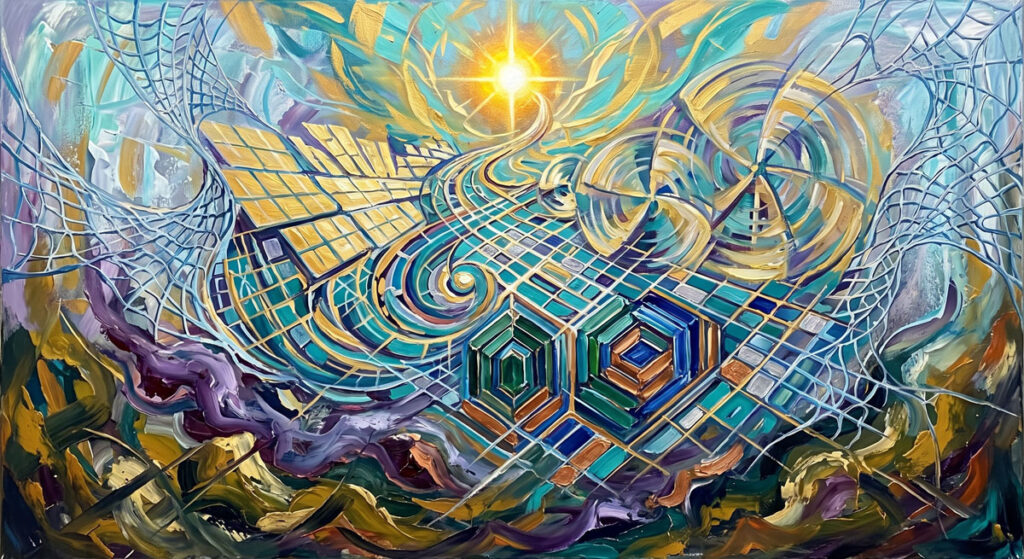
Nocturnal Cloud Correspondent Pritish Beesooa examines whether confronting global warming requires more than cleaner technology, and asks if the next stage in capitalism’s evolution could place environmental responsibility within the architecture of capital itself.
Can we technology our way out of global warming? It is one of the great hopes of our age. Build better batteries, cover more rooftops with solar panels, construct larger wind farms, develop cleaner fuels and capture carbon from the atmosphere. Artificial intelligence might optimise our electricity grids, while nuclear fusion may one day deliver the abundance its advocates have promised for generations.
Some of these technologies are already transforming how we produce and consume energy. Others remain expensive, experimental or frustratingly distant. Almost certainly, we will need a combination of them. But they all share something fundamental: someone has to pay for them.
Behind almost every technological answer to climate change sits another system that receives considerably less public attention: the machinery deciding where capital goes. A battery factory requires investment. A wind farm requires financing. A forest restoration project needs somebody willing to fund it. Rebuilding cities, transport networks and energy systems for a warmer world will require extraordinary amounts of public and private capital.
Perhaps, then, climate change is not only an engineering problem. It is also a problem of capital architecture.
There may be another reason it sits so awkwardly within the institutions we have constructed. InHyperobjects, philosopher Timothy Morton gives a name to phenomena so massively distributed across time and space that we struggle to experience them as a complete whole. Global warming is perhaps the defining example. We do not wake up and see climate change itself. We see fragments: a flooded town, a burning forest, a bleaching reef, a disappearing glacier or another temperature record quietly broken. The thing connecting them is vastly harder to hold within the human imagination.
Our financial systems face a strangely similar problem. They are extraordinarily sophisticated at assigning value to things that can be identified, owned and exchanged. A barrel of oil can be priced, as can a tonne of timber or a hectare of land. But what is the value of the tree that was never cut down? What price belongs to carbon never released, a species that did not become extinct or an ecosystem allowed to remain intact for another century?
Their value may be enormous, but much of it belongs to everybody, including people who have not yet been born. Climate change therefore confronts capitalism with problems of both value and time. A forest cleared today can generate an immediate return, while the benefits of leaving it standing may accumulate across generations.
Capital operates within investment horizons. The climate does not.
None of this means profit itself is the enemy. Capitalism has financed extraordinary innovation and repeatedly reinvented the institutions through which money is organised. Private equity is one example. It can pool enormous quantities of capital, concentrate expertise, take meaningful ownership positions and transform businesses over longer periods. Those capabilities could prove immensely useful in a transition requiring vast investment.
But private equity also reveals something fundamental: capital is governed. Someone establishes the investment mandate, decides what constitutes an acceptable return and determines which consequences enter the calculation.
The corporation was not inevitable. Neither was the stock exchange. Limited liability, venture capital and private equity were innovations, new architectures for organising ownership, risk and economic power.
Capitalism has never stopped evolving. Why should we assume its present institutions represent its final form?
One unlikely answer may be emerging from a world better known for cryptocurrency speculation than environmental responsibility: the Decentralised Autonomous Organisation, or DAO.
Strip away the jargon and the proposition is relatively simple. People can organise around capital and a common purpose while distributing elements of governance beyond the conventional boardroom. Participants may possess governance rights, transactions and decisions can be recorded on a blockchain, and smart contracts can automate agreed rules.
None of this automatically makes an organisation democratic or ethical. But the architecture is different.
Perhaps the mistake has been to understand that architecture only through cryptocurrency. Don Tapscott, who with Alex Tapscott helped popularise a broader interpretation of blockchain in Blockchain Revolution, has argued for its significance beyond digital currencies, particularly in reorganising trust, transactions and economic coordination.
Seen this way, the DAO looks less like a rebellion against capitalism and more like another chapter within it.
The corporation distributed ownership and risk. Stock markets expanded participation. Venture capital financed uncertainty. Private equity developed concentrated ownership and active intervention. None replaced capitalism. They changed how capitalism organised itself.
Perhaps the DAO is not capitalism’s opponent, but one of its possible descendants.
Imagine taking some of private equity’s strengths: pooled capital, specialist expertise, longer investment horizons and active ownership. Now combine them with more transparent governance, verifiable commitments, broader participation and rules establishing from the beginning that financial return is not the only outcome against which success will be measured.
For much of modern capitalism, responsibility sat around the edges of investment. Companies generated profits and later engaged in philanthropy. Corporate social responsibility brought consequences closer to the organisation, while ESG attempted to incorporate environmental, social and governance considerations into investment decisions.
The DAO raises a subtly different possibility.
What if responsibility sits inside the architecture of the investment itself?
This is where Kevin Owocki’s work around public goods and regenerative cryptoeconomics becomes interesting. Through Gitcoin and experiments such as quadratic funding, Owocki has explored ways of directing resources towards forms of shared value conventional markets can struggle to fund.
The mathematics matter less here than the principle: change the rules of allocation and you can change what capital rewards. Climate change provides an extraordinary test because a stable climate is, in effect, a public good.
Consider a hypothetical £100 million investment vehicle established to restore mangrove forests across vulnerable coastlines. A conventional investor would reasonably ask about costs, risks and return. A climate DAO would still need credible answers. Ethics cannot become an excuse for poor economics.
But it might ask other questions too. How much carbon has been captured? Has biodiversity improved? Has flood resilience increased? Have nearby communities benefited? Who verifies those claims? And what happens if the investment becomes financially successful while failing the people or ecosystems it was created to protect?
Financial return remains visible, but stops being the only measure capable of defining success. Communities could possess defined governance rights. Environmental specialists might establish thresholds. Independent evidence could verify outcomes while investors continue to demand financial discipline. Consequences previously pushed outside the investment calculation begin moving inside it. We might call this programmable accountability.
Smart contracts could release capital against independently verified milestones, while governance rules could make environmental commitments part of the investment from inception. That does not mean reducing every tree or species to a token. A rainforest does not acquire moral worth because somebody attaches a digital asset to it. The more interesting question is whether finance can become better at recognising value that was already there.
Sometimes the environmentally valuable act is precisely the thing that does not happen: coal remains underground, a forest remains standing, a wetland is not developed, carbon is never emitted. How do we construct an economy capable of rewarding absence?
If capitalism is to function within ecological limits, it may have to become as sophisticated at recognising preservation as it has historically been at recognising extraction. Yet an uncomfortable question hangs over the proposition: does putting capitalism on a blockchain actually change capitalism?
Perhaps not.
There is nothing inherently ethical about decentralisation. Governance tokens can accumulate in relatively few hands, participation can decline, technical complexity can create new insiders and speculation can overwhelm purpose.
Decentralised in name does not necessarily mean decentralised in power.
Economist Eswar Prasad’s work on the future of money provides a useful warning. Digital technologies can make finance more efficient and potentially broaden access while creating profound questions around privacy, stability and institutional power. Changing the technology through which money moves does not automatically change the interests controlling it.
Technology does not remove politics. Sometimes it merely moves politics into code.
Code creates another problem. Suppose our mangrove DAO reaches its carbon target, but local fishing communities lose access to waters on which they have depended for generations. What if biodiversity improves according to one measurement while livelihoods deteriorate according to another?
The data might be accurate while the definition of success is wrong. No algorithm resolves that argument for us. The danger of programmable accountability is that we confuse what can be measured with what matters. A forest is more than a carbon store. An ocean is more than a quantity of sequestration. A community is more than an impact metric.
Technology cannot put ethics at the core of capitalism. Only people can do that.
What technology may change is the architecture through which those choices are expressed. Blockchain can make commitments visible. Smart contracts can make conditions enforceable. Distributed governance can give previously excluded stakeholders a formal role.
But none can tell us what justice looks like. The credible future may therefore be hybrid: professional management where expertise is necessary, regulation where public protection is required, participation where consequences are shared, and programmable rules where commitments can be verified.
Decentralisation does not have to mean eliminating institutions. It may mean redesigning them. This is where Nobel Prize winning economist Elinor Ostrom offers an important reminder. Her research into governing common resources challenged the assumption that communities inevitably destroy what they share. Under appropriate conditions, rules, participation, monitoring and accountability can allow common resources to be governed successfully.
The atmosphere is a commons on a scale almost beyond comparison. No DAO has demonstrated that it can govern something so vast. The question is whether digital governance might help institutions represent more of the people, consequences and timescales affected by capital than existing structures routinely do.
The community downstream. The forest without a shareholder. The atmosphere without an owner. The generation without a vote.
That would not abolish capitalism. It would ask capitalism to account for more of the world in which it operates.
The objective is not to remove profit from capitalism. Investors will seek returns, entrepreneurs will build companies and innovation will require reward.
It is to stop pretending profit is the only form of value capitalism is capable of recognising.
Climate change is perhaps the greatest unpaid invoice industrial capitalism has ever produced. For generations, much of the cost of carbon could be pushed somewhere else: into the atmosphere, onto another country, towards a poorer community or forward into another century.
The atmosphere never sent the bill. Now it is arriving in other forms. Flood defences, crop failures, insurance losses, heat adaptation, disrupted supply chains and damaged infrastructure are beginning to turn yesterday’s externalities into today’s economic costs. What once appeared outside the balance sheet is finding its way back onto it.
So can we reprogramme capitalism? Not in the simplistic sense that smart contract code can repair an economic system centuries in the making. Ethics cannot be automated, justice cannot be reduced to an algorithm and no blockchain can decide what one generation owes the next. But institutions can be redesigned. Rules, incentives and definitions of value can change. That is what capitalism has been doing throughout its history.
We will still need better batteries, renewable energy, cleaner transport, carbon removal, artificial intelligence, perhaps fusion and technologies not yet imagined. But each eventually encounters the same questions: who decides what gets funded, what constitutes success and which consequences count?
Perhaps we have spent too long asking whether capitalism and climate responsibility can coexist. The more interesting question is whether capitalism can become sophisticated enough to recognise not only the value it creates, but the value it chooses not to destroy.
The DAO will not save the planet simply because it runs on a blockchain. But perhaps it offers a glimpse of an architecture in which environmental responsibility no longer waits outside the room until after the financial decisions have been made. Perhaps the DAO is not capitalism’s opponent at all.
Perhaps it is one glimpse of what capitalism could become next.