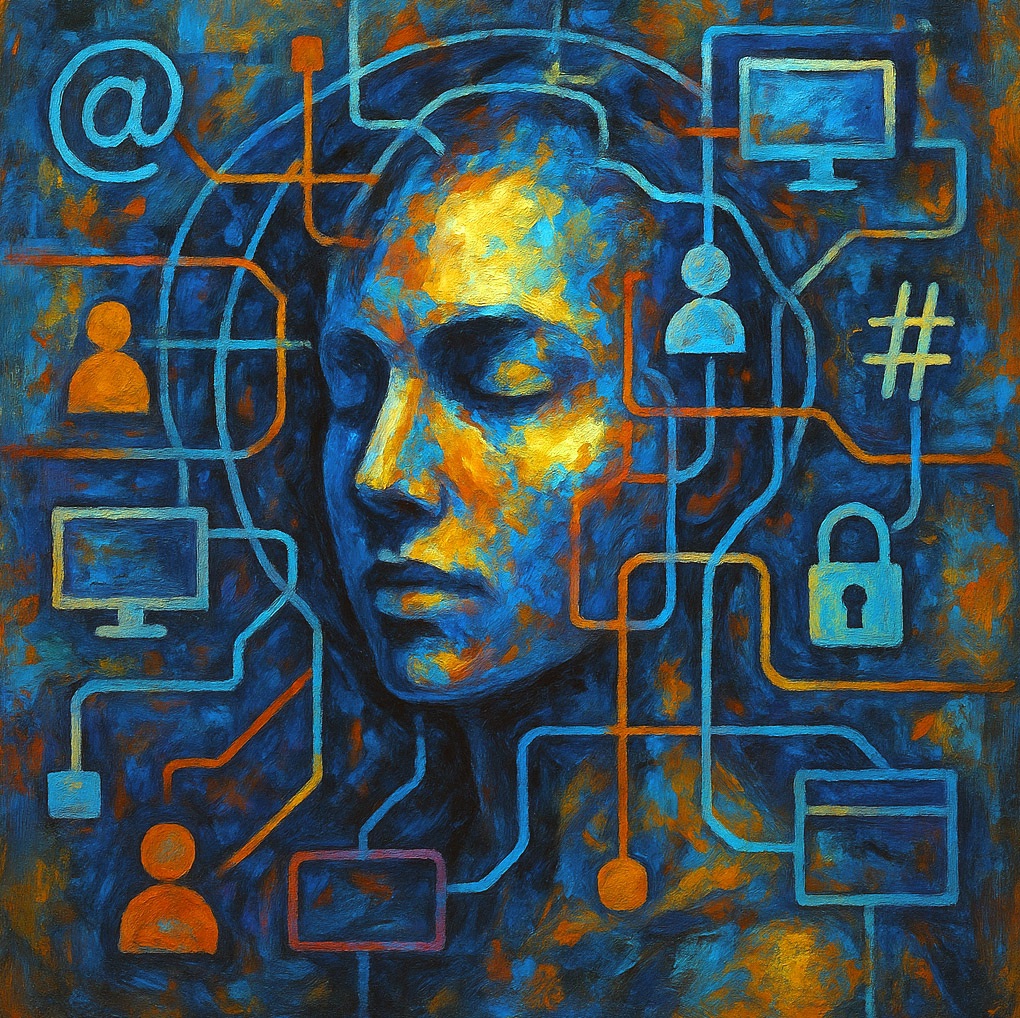
For all the talk of digital transformation, the architecture of online identity remains stubbornly archaic. Every interaction from opening a bank account to joining a social platform demands the same ritual of proving who we are, again and again, to companies that insist on holding our data while repeatedly failing to protect it. The result is a global system that is simultaneously intrusive, inefficient, and astonishingly fragile.
The idea behind ‘Soulbound Tokens’ (not the kind one would find and collect in games) enters this landscape as a challenge to the basic assumptions that have shaped digital identity for two decades. Instead of scattering personal data across countless private servers, Soulbound Tokens (SBTs) propose that identity should be anchored to the individual, cryptographically bound rather than platform-owned, portable rather than endlessly duplicated. In doing so, they pose a question that cuts to the centre of contemporary digital life: why should corporations act as the custodians of our identities when technology now allows us to hold them ourselves?
This is not a conversation about speculative assets or the excesses of the NFT boom. It is about the future of verification, trust, and autonomy in an internet increasingly defined by uncertainty. If traditional KYC frameworks were built for an earlier era, one shaped by paperwork, physical documents, and centralised gatekeepers, then SBTs represent the possibility of an identity model that travels with the user, not the institution. A model that could, in theory, reduce fraud, simplify compliance, and restore a measure of dignity to the digital citizen.
But the promise is not merely technical. It carries deep political and philosophical implications. What happens when identity becomes non-transferable, cryptographically secured, and permanently attached to us? What new forms of power are created or dismantled for that matter when individuals control the keys to their own verification? And can a decentralised credential ever deliver the privacy, flexibility, and ethical safeguards that a fair digital society demands?
These are the tensions at the heart of the debate. Soulbound Tokens are not a solution waiting to be implemented; they are a provocation. They force us to ask whether the next evolution of Web3 is not about ownership of assets, but ownership of self and whether the systems we rely on today are capable of adapting to that shift.
WHY THE INTERNET IS BROKEN: THE DATA EXTRACTION ERA
For all its sophistication, the modern internet is built on an identity infrastructure that barely functions. The average user maintains dozens of fragmented accounts, each requiring separate credentials, each storing overlapping versions of the same information, and each governed by opaque, proprietary systems that treat identity as corporate property. It is an ecosystem optimised not for user agency, but for data extraction.
The logic of Web2 shaped largely by platforms such as Meta and Google, turned personal data into the world’s most valuable commodity. Every login, interaction, and verification produces trace data that feeds profiling engines whose true workings remain inaccessible to the public. Users are asked to surrender information repeatedly yet rarely given meaningful control over where it resides or how it circulates.
This model also created structural inefficiency. Institutions ranging from banks to healthcare providers duplicate KYC procedures because identity is siloed by design. No system trusts the attestations of another; no credential is portable. As a result, verification has become a recurring friction point across industries. Compliance systems remain costly, fraud continues to evolve, and the burden falls disproportionately on individuals who must repeatedly hand over sensitive documents without any guarantee of security.
The consequences have been significant. Data breaches have exposed billions of records worldwide. Centralised databases from telecommunications to finance have become single points of failure. Even when these systems function as intended, they reinforce a model of digital citizenship in which the user is continually subordinated to the verification requirements of institutions whose main priority is risk mitigation, not individual autonomy.
This is why the current model is increasingly seen as unsustainable. Regulators acknowledge its shortcomings, privacy advocates warn of systemic overreach, and technologists point to the inherent limitations of a system that requires perpetual re-authentication rather than granting users a persistent, verifiable digital identity. The internet’s identity layer was never designed to scale to global society, and the cracks are now impossible to ignore.
Soulbound Tokens enter the debate precisely at this pressure point. By shifting verification away from platform-owned databases and towards the individual, they confront the core dysfunction of the existing system: its dependence on centralised repositories of personal data. Instead of multiplying identity copies across the internet, an SBT framework would consolidate credentials into a single, user-controlled identity primitive.
The question, then, is not whether the Web2 identity model is failing, it already has. The question is whether a decentralised alternative can deliver trust without re-creating the same patterns of control and surveillance under a different name.
NFTs OPENED THE DOOR, BUT THEY WEREN’T THE SOLUTION
The rise of non-fungible tokens was one of the strangest cultural moments of the last decade. For a brief period, the worlds of digital art, finance and celebrity collided in a way few had anticipated. When the digital artist Beeple sold a collage for a sum normally reserved for blue-chip paintings, and when projects like CryptoPunks and Bored Ape Yacht Club began circulating through auction houses and the social feeds of musicians such as Snoop Dogg, it became clear that something more significant was unfolding beneath the spectacle.
For the first time, ordinary users were exposed to the idea that ownership online could be decisive rather than symbolic. An artwork stored in a digital wallet could be proven authentic. A file could have a lineage. A record of creation and transfer could exist independently of any single company. At a conceptual level, NFTs demonstrated a profound hunger for clarity in a digital world that had long blurred the boundaries between possession and access.
Yet the success of NFTs carried within it the seeds of their limitation. Their architecture was designed for circulation, their value defined by their ability to move between buyers. This made them well suited for digital art and collectables but ill equipped for the kinds of credentials that shape identity. A degree, a licence, a citizenship document or a professional accreditation is meaningful precisely because it is attached to a specific individual. If it were transferable, it would lose its authority. The very liquidity that made NFTs compelling rendered them incapable of representing anything that required permanence.
The culture that grew around NFTs intensified this mismatch. Markets surged and fell with the velocity of speculative finance. Images that were meant to signal community quickly became shorthand for volatility, and the technology’s underlying promise was often drowned out by noise. Instead of inaugurating a new relationship between people and their digital identities, the NFT boom highlighted how easily innovation can be subsumed by the incentives of trading platforms. The public learned to associate decentralised verification with abrupt price movements rather than structural reform.
Despite this, the NFT wave performed a critical function. It revealed that millions of people were prepared to engage with cryptographic proof as a form of legitimacy. It normalised the idea that a record stored on a public ledger could carry social meaning. And it created a technological vocabulary that would later be repurposed for more ambitious aims.
That is the point at which Soulbound Tokens enter the conversation. They draw from the same principles of verifiable provenance yet invert the assumptions that defined the NFT era. Where NFTs expressed what a person owned, SBTs aim to express what a person has achieved or been formally recognised for. Where NFTs derived value from mobility, SBTs derive meaning from their inability to be transferred. They are designed not to circulate but to anchor, not to be traded but to signify.
Seen from this perspective, the NFT movement looks less like a failed promise and more like a necessary precursor. It familiarised the public with decentralised ownership, demonstrated the power of cryptographic proof and exposed the shortcomings of systems built solely around assets. What it could not offer and what it was never designed to offer was a mechanism for identity itself.
The real significance of NFTs, then, lies in what they made visible: that the next transformation in the digital landscape would not revolve around collectables, but around the individual. They opened the door. Soulbound Tokens step into the space beyond it, asking whether digital identity can evolve from a market object into something far more consequential: a stable, verifiable, user-owned expression of personhood in an internet that has long treated identity as an afterthought.
SOULBOUND TOKENS: WHAT THEY ARE AND WHY THEY MATTER
The emergence of Soulbound Tokens marks a deliberate shift in the evolution of Web3. When the idea was first articulated in a paper co-authored by Vitalik Buterin, economist E. Glen Weyl and legal scholar Puja Ohlhaver in 2022, it stepped beyond the narrow concerns of asset ownership and speculation and entered the terrain of social infrastructure – the mechanisms by which individuals prove, assert and mobilise their place in digital society.
At a basic level, a Soulbound Token is a non-transferable digital credential. Unlike the NFTs that dominated early conversations around blockchain, these tokens are not designed for trading, speculation or market-driven exchange. Instead, they are permanently linked to an identity or rather what the paper’s authors call a “soul.” According to Buterin and his co-authors, the purpose of SBTs is to enable networks of trust and provenance that mirror real-world social connections, using cryptographic verification rather than centralised databases to ensure authenticity.
As Buterin described the concept, imagine an internet in which “most participants have Souls (digital wallets) that store SBTs corresponding to a series of affiliations, memberships, and credentials,” allowing a digital ecosystem to encode trust networks rather than merely financial transactions. This formulation positions SBTs as more than just a technological innovation; they are proposed as infrastructure for a Decentralised Society (DeSoc) — a layered system of attestations that together form a composite identity each person carries with them.
What distinguishes Soulbound Tokens from the first wave of tokenisation is this focus on permanence and specificity. Where NFTs could be handed from one wallet to another, SBTs cannot. They are bound to the holder once issued, like a diploma that cannot be reassigned or a licence that cannot be sold. This immutability is intentional: it encodes reliability. With SBTs, the weight of a credential comes not from the market but from the fact of issuance and the underlying authority of the issuer. A university’s attestation of a degree, a regulatory body’s certification of compliance, a healthcare institution’s record of immunisation — all become verifiable onchain, readable by any system that needs assurance of authenticity.
The potential applications are broad. Academic credentials could be cryptographically verifiable without endless paperwork. Professional licences could be instantly trusted across borders. KYC attestations could travel with the individual instead of being repeatedly submitted to each new service. Each token represents a claim about the holder that others can verify without intermediaries. This breaks with the current model, in which identity verification is siloed, repetitive, and dependent on the goodwill and security practices of corporations and central authorities.
Deeply embedded in this concept is a rethinking of trust itself. In a traditional society, trust is mediated through institutions and documents. In the Web3 vision that SBT proponents outline, trust is instantiated in a distributed system of shared attestations, where each credential reinforces a network of reputational claims. For the first time, identity becomes both portable and persistent, held by the individual yet verifiable by any validator with access to the underlying ledger.
Yet the logic of permanence raises unavoidable questions about control, privacy and agency. If a token attests to a past affiliation or accomplishment, who governs its issuance? What are the limits of accountability when credentials are immutable? What safeguards prevent social and economic stratification encoded into tokenised identities? These are not speculative concerns. They foreshadow the terrain on which SBTs will be debated, regulated and potentially contested.
Philosophically, the narrative behind Soulbound Tokens intersects with longstanding debates about autonomy and recognition. The idea that an individual should hold the keys to their own identity rather than a corporation or a state or platform resonates with liberal notions of agency. Yet it also raises the spectre of an identity layer that is permanent by design, potentially unforgiving of change or redemption. The power dynamics embedded in an immutable record must be thoughtfully governed if the benefits are to outweigh the risks.
In shaping the next generation of digital identity, SBTs thus represent both a technological proposition and a social contract. They extend the early insights of cryptographic ownership into the realm of lived experience and propose a model where these facets of life can be verifiably portable without surrendering control to intermediaries.
Whether Soulbound Tokens will fulfil this promise remains uncertain. They are neither fully specified in practice nor broadly adopted. But as a conceptual leap, a proposal to recast identity as sovereign, verifiable and decentralised, they have undoubtably shifted the conversation. At a moment when the limitations of platform-owned identity have become painfully obvious, SBTs suggest a path toward an internet that recognises individuals not as soulless accounts but as bearers of enduring credentialed identities.
CAN SOULBOUND TOKENS DECENTRALISE KYC?
The promise of Soulbound Tokens becomes most tangible when applied to a system that almost everyone agrees is inefficient, costly and chronically outdated: Know Your Customer, or KYC. The current framework relies on an architecture that predates the digital era, yet it continues to govern online finance, banking, payments, investment platforms and increasingly even everyday digital services. Its logic is simple: institutions must verify who a user is before allowing them to transact. Its execution, however, is laborious for institutions and exhausting for individuals.
KYC asks users to repeatedly submit the same documents such as passports, driving licences, proof of address to systems that do not communicate with one another, do not trust one another, and do not recognise the validity of each other’s verification procedures. The result is a global compliance landscape built on duplication. Identity is reconstructed anew each time a person interacts with a platform, and each reconstruction produces another copy of sensitive data stored on infrastructure that varies widely in security standards. The system is expensive to maintain and remarkably fragile, yet no viable alternative has gained sufficient traction to replace it.
In theory, Soulbound Tokens offer a way to reimagine this process from first principles. Instead of every institution gathering raw personal data and storing it in isolation, the verification itself could be issued as a credential and anchored to the individual. A regulated entity such as a bank, a government office or a certified KYC provider could perform the verification once and issue a cryptographically secure, non-transferable token attesting that the necessary checks have been completed. Any other institution could then validate the attestation directly from the chain without ever needing to handle the underlying personal documents.
This would not eliminate KYC, but it would decentralise its footprint. It would shift the model from repeated verification to reusable verification, from siloed databases to portable attestations, and from institutional custody of personal data to user-controlled credentials. Such a system aligns closely with the original argument made by Buterin and his co-authors, who noted that the existing identity layer of the internet is both fragmented and vulnerable, whereas a decentralised model offers the possibility of “richer, pluralistic systems of trust.”
The potential gains are significant. For institutions, an SBT-based identity layer could reduce compliance costs, streamline onboarding, and strengthen fraud prevention by relying on attestations that cannot be forged or transferred. For individuals, it offers a tangible shift in power: the ability to carry one’s verification across platforms without repeatedly surrendering sensitive documents. It also reduces the attack surface created by thousands of fragmented identity repositories.
Yet the decentralisation of KYC raises questions that cannot be ignored. A permanent credential, even one designed for privacy-preserving verification, demands safeguards. Users must retain the ability to revoke or update credentials when circumstances change. There must be governance models that prevent misuse, coercion or discrimination based on tokenised identity profiles. Regulators will need to determine how decentralised attestations fit within existing AML and counter-terrorist financing obligations, and whether the public blockchain layer can be reconciled with data-protection frameworks that emphasise erasure and minimisation.
There is also a deeper philosophical tension. KYC is ultimately a system of classification; it creates boundaries between the trusted and the untrusted, the permissible and the prohibited. Embedding these classifications into an immutable identity layer risks entrenching those boundaries unless mechanisms of appeal, redress and reinvention are built in. The work of scholars such as Hannah Arendt, who emphasised the importance of the “right to have rights,” and Eva Kittay, who highlighted the relational nature of dependency and vulnerability, provides a critical lens for understanding what is at stake. Identity is not static. Recognition must allow for change.
For decentralised KYC to function as more than a technical upgrade, it must adopt these ethical considerations as part of its architecture. A system that encodes verification without encoding a path to correction would merely reproduce the rigidity of bureaucratic identity in a new, cryptographic medium. The ambition of SBTs is to avoid exactly that: to provide trust without surrendering agency, and verification without compromising dignity.
If implemented with care, Soulbound Tokens could shift KYC from being a burdensome checkpoint into an interoperable layer of assurance that travels with the individual. If implemented poorly, they risk creating a new kind of digital rigidity, one that echoes the very problems they seek to solve.
The question, therefore, is not simply whether SBTs can decentralise KYC. It is whether they can decentralise it without repeating the structural failures of the centralised model. The answer will depend on how much governance, flexibility and user sovereignty the industry is prepared to embed into the foundation of its next identity system.
DATA MONETISATION, A RADICAL SHIFT: THE FUTURE BEYOND SOULBOUND TOKENS
The most provocative consequence of a decentralised identity framework is not its impact on verification or compliance, but the transformation it hints at in the economics of digital life. For two decades, the internet has been structured around an asymmetry so entrenched that it is rarely questioned: platforms extract data, monetise it, and return only convenience in exchange. Individuals produce the raw material yet hold no ownership stake in its value.
Soulbound Tokens complicate this arrangement. If identity becomes user-owned, then the data attached to that identity no longer sits in institutional silos. Verification becomes portable, credentials become reusable, and personal information becomes something closer to an asset an individual can hold rather than a resource they are compelled to surrender. In this model, the individual is no longer the product. They are the point of origin.
The idea is still embryonic, but its implications are significant. A decentralised credential system could support user-driven data markets in which people choose when and how to share their information. A financial institution might request access to a compliance attestation; a healthcare provider might request a medical credential; a travel service might wish to verify a set of permissions. Instead of supplying documents and abandoning control, users could grant temporary access to verifiable attestations, revoke that access when it is no longer needed, and in certain contexts monetise their participation if they choose.
For industries such as tourism, education, healthcare, and the creator economy, the shift would be profound. Diaspora communities could carry their identity proofs across borders; students could port recognised credentials between institutions; creators could authenticate their work without intermediaries; patients with chronic conditions could benefit from verifiable continuity of care. The informational burdens that currently fall on individuals could redistribute to systems that recognise identity as sovereign rather than extractive.
Yet the prospect of individuals monetising their data also invites caution. If autonomy expands, the potential for exploitation expands with it. Markets that commodify human attributes — achievements, affiliations, reputations — must be designed with care, lest they reproduce inequalities under the guise of empowerment. A world in which individuals profit from their data could inadvertently become one in which individuals are pressured to do so. The question is not simply whether people can monetise their data, but whether they should feel compelled to enter markets structured by asymmetrical bargaining power.
Here, the philosophical stakes resurface. As Martha Nussbaum notes in her work on capabilities, true agency depends not merely on the availability of options, but on the substantive freedom to choose among them. A decentralised identity system that confers theoretical control without practical safeguards risks creating a new rhetoric of empowerment without meaningful protection. Hannah Arendt’s reflections on the “right to have rights” remain instructive: identity must not only be portable and verifiable; it must be shielded from coercion, surveillance and categorical exclusion.
This is the paradox that defines the future of Soulbound Tokens. They hold the potential to dismantle the most extractive features of Web2 and replace them with an architecture that respects autonomy, privacy and user sovereignty. Yet the same permanence that gives them strength could, without robust governance, entrench disadvantage or harden reputational boundaries. If SBTs are to reconfigure the digital landscape, they must do so alongside mechanisms of revision, redemption and contestation.
The shift from platform-owned identity to user-owned identity is not a technical adjustment. It is a structural rebalancing of power. If it succeeds, the internet could move towards an era in which individuals carry their credentials with them, consent to data sharing on their own terms, and engage with digital systems as agents rather than subjects. The decentralisation of identity could become the foundation for a more equitable digital economy. If it fails, it could create new forms of rigidity, new hierarchies encoded in code, and new vulnerabilities for those least equipped to navigate them.
The promise of Soulbound Tokens lies not in their existence, but in the governance choices still to be made. They offer a blueprint for an identity system that centres the individual rather than the institution, and a future in which data is no longer extracted but exchanged — sometimes monetised, sometimes withheld, always controlled by its creator.
That vision is not guaranteed. It is an argument in progress, a conceptual shift still being tested, debated and refined. But it marks a rare moment in the trajectory of the digital world: a chance to rebuild the foundations of identity on terms that reflect not only technological possibility, but human dignity. And if the next era of the internet is to mean anything at all, it will begin with that question of ownership: not ownership of assets, but ownership of self.
By Pritish Beesooa,
Head of Web3 Development