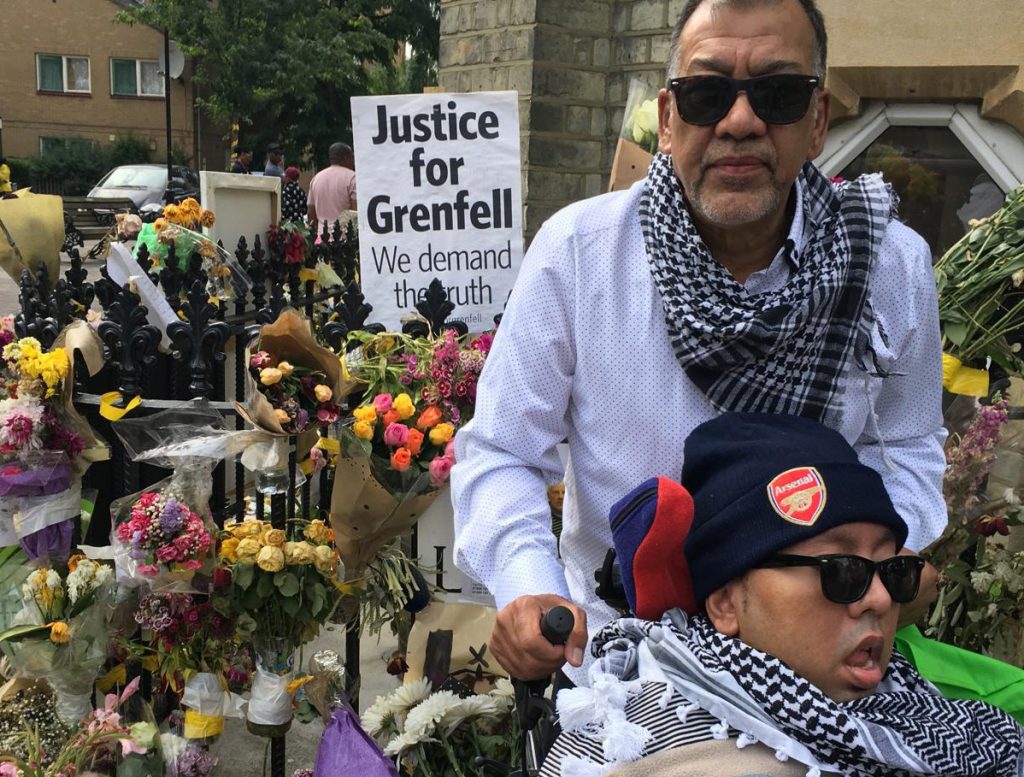
Every year, on International Disability Day, the world pauses to acknowledge the lives that modern society too often overlooks. It is a day intended for reflection, for accountability, and for recognising the dignity, resilience and humanity of millions whose stories rarely reach the front pages. This year, amid the usual declarations of commitment, policy statements, and corporate pledges, one story stands out with the kind of quiet force that compels deeper attention: the life journey of Sadam Hossenally.
Sadam was born on 25 September 1990 at the modest yet respected Reduit Private Clinic, to Cader and Husna Hossenally, a Mauritian-born British family already familiar with the balancing act between two homelands. They named their son ‘Sadam’, drawn from the Arabic tradition, meaning “he who confronts” or “he who stands strong.” At the time, they had no idea how prophetic that choice would become. By nine months old, they noticed he could not hold his head upright; by his first birthday, concerns grew more urgent. It was during a visit by family doctor ‘Navin Ramgoolam’, long before his rise to political leadership, that the quiet alarm became decisive advice: Sadam needed specialist evaluation, and he needed it urgently.
Soon after, the family found themselves navigating the corridors of Great Ormond Street Hospital, one of the world’s foremost paediatric institutions. In 1992, under the stark glow of clinical lighting, surrounded by medical teams and unfamiliar machinery, they received the diagnosis that would redefine the arc of their lives. Sadam had leukodystrophy, a rare neurodegenerative disorder, and the prognosis was delivered with gentle clarity: he was unlikely to live beyond five years.
But this article is not a memorial or an obituary of a life caught short. Rather, it is a celebration because in September 2025, Sadam marked his 35th birthday, living three decades beyond the boundaries set by medical expectation. His life is a testament to meticulous care, parental devotion, and a resilience that transcends the limits of biology. And as we reflect on International Disability Day, Sadam’s story does something that policy speeches rarely achieve: it reveals the lived reality behind the word disability, and the structures (social, economic, technological) that shape it. It asks what Sadam’s life tells us about the future of disability support at a time when our technological landscape is shifting at unprecedented speed. We now inhabit a world where AI monitors home environments, where smart devices assist with communication and movement, where decentralised digital identities secure health records, and where Web3 advocates imagine reorganising care through distributed networks and immutable data trails. And yet, even amid such innovation, the experience of disability remains shaped by human labour: the carer’s touch, the intuition of parents, the precariousness of social support systems, and the cultural resilience passed through diasporic communities.
Sadam’s life, situated between Mauritius and Britain, between medical fragility and extraordinary survival, between old-world caregiving and new-world technology, invites a profound rethinking of how society understands disability and how emerging technologies could transform, support, or even complicate that understanding.
On International Disability Day, when many speak in abstractions, Sadam’s story brings us back to the specifics: a child who wasn’t expected to live, a family who refused to surrender, and an unfolding question about the world we are building — technologically, ethically, and socially — for those whose lives depend on care, community, and innovation working hand in hand.
Redefining Disability in a Technological Age
To speak about disability today is to speak about much more than medicine. It is to speak about history, infrastructure, technology, economics, and the moral choices societies make about who gets supported and who gets left behind. International Disability Day reminds us annually that disability is not simply a personal condition, but a collective responsibility and a moral obligation. It is a mirror reflecting how inclusive, compassionate, and forward-looking we truly are.
For decades, disability was framed almost exclusively through the lens of the medical model, which viewed impairments as problems housed within the individual. When Sadam was diagnosed with leukodystrophy in 1992 at Great Ormond Street Hospital, that framework shaped nearly every conversation. Doctors focused on symptoms, deterioration, and prognosis charts. Families were counselled on limitations rather than possibilities. The future was mapped in terms of what would not happen: he would not walk, not speak, not reach adolescence. The diagnosis was treated as destiny.
Yet from the late 20th century onward, disability scholars began challenging this narrow view. Thinkers like Mike Oliver and Tom Shakespeare argued that disability does not arise solely from the body, but from the environment that surrounds it. Inaccessible buildings, inflexible systems, unaffordable equipment, and untrained institutions disable far more people than their diagnoses do. This social model transformed the conversation: disability is not simply biological; it is architectural, economic, political. It lives in policies as much as in muscles. In this framework, Sadam’s disability cannot be understood apart from the support structures that shaped his life: the adaptability of his home, the responsiveness of the UK healthcare system, the availability of social workers, the reliability of equipment, and the dedication of carers who became the backbone of his survival.
But a third layer now defines disability in the 21st century: the technological one. As digital systems mediate more and more of daily life, disability increasingly depends on access to or exclusion from these technological infrastructures. Scholars in digital disability studies, such as Gerald Goggin and Katie Ellis, argue that accessibility today is inseparable from tech design: who gets to participate in digital services, who can navigate platforms, who benefits from automated systems, and who is marginalised by them. The digital divide is no longer about owning a computer; it is about whether essential technologies understand the needs of disabled people at all.
This matters profoundly in the story of Sadam. When he was diagnosed, the digital world was only beginning to take shape. There were no mobile apps to coordinate care, no assistive communication platforms, no remote-access medical portals, no integrated case-management dashboards. Hospital records were stored in filing cabinets, carers communicated through phone calls and letters, and families carried the emotional labour of advocacy without the technological scaffolding available today. Sadam’s childhood was shaped not only by leukodystrophy, but by the absence of technologies that might have eased the journey.
Today, Web2 tools have already transformed aspects of disability care. Smartphones help carers track appointments; telehealth removes the burden of unnecessary travel; online communities connect families facing similar diagnoses across continents. But Web3 introduces an even more dramatic shift: the idea that disability support systems could be decentralised, automated, and secured through cryptographic trust rather than bureaucratic complexity. In this emerging landscape, smart contracts could automate benefit distribution, ensuring carers are paid on time; decentralised identity technology could protect medical data while making essential information instantly verifiable; blockchain audit trails could prevent the loss of medical records and reduce administrative errors; decentralised autonomous organisations (DAOs) could allow disability communities to govern their own support funds transparently, democratically, and without political interference.
Already, glimpses of this future exist. Estonia’s national health infrastructure uses blockchain to safeguard citizen medical files, preventing tampering and improving trust. Startups across Asia and Europe are designing AI-driven mobility and communication tools tailored to degenerative conditions. In the UK, pilot programmes have explored using distributed ledgers for care-record consistency across social services, a small but significant step toward ensuring that someone like Sadam never falls between institutional cracks.
Through all of this, one truth emerges: disability today is not merely a matter of biology; it is a relationship between the individual and the technological, social, and political environment that surrounds them. To understand Sadam’s life, to understand why he is alive at 35 despite every bleak prediction is to understand the extraordinary human resilience of his family, but also the systems that either supported or failed them. International Disability Day asks us to confront these systems honestly.
Disability, then, is best understood as the point where human fragility meets societal design and technology has become one of the primary architects of that design. The question now is not whether disabled people can keep up with technology, but whether technology will finally be built to keep up with them.
Understanding Leukodystrophy: The Scientific Reality and the Human Cost
Leukodystrophy is one of those diagnoses that collapses time. It takes a single moment and reshapes an entire family’s future. Clinically, leukodystrophy refers to a group of rare genetic disorders that attack the myelin sheath, the protective insulation around nerve fibres. Without myelin, the electrical signals that allow us to move, swallow, think, or even breathe begin to falter. Muscles weaken. Motor skills regress. Everyday actions become laboured, then impossible. In the early 1990s, when Sadam was diagnosed at Great Ormond Street Hospital, there were no meaningful treatments, little global research, and a prognosis that hovered between months and a handful of years.
But no scientific description captures the lived experience. To understand leukodystrophy, you must imagine the quiet alarm in a parent’s mind when milestones don’t arrive; the weight of a head that cannot lift; the strain of a swallow that doesn’t come; the hospital corridors where fear becomes a constant companion. These diseases reorganise not just the body, but the household, calendar, finances, emotional tone, and future of a family.
In a sense, the world had already been offered a cultural window into this reality through the 1992 film Lorenzo’s Oil, starring Susan Sarandon and Nick Nolte. Although centred on adrenoleukodystrophy (a specific form of leukodystrophy), the film gave mainstream audiences a glimpse (dramatised but deeply human) of what degenerative neurological conditions demand of children and their families. The long nights of research, the endless fight against medical inevitability, the relentlessness of hope. While Sadam’s form of leukodystrophy was different, the emotional architecture was similar: a family grappling with a disease that medicine could describe but not stop.
In Mauritius, where Sadam was born, advanced neurological care was limited in the early nineties. His parents British nationals of Mauritian origin, found themselves navigating a liminal space between countries, systems, and identities. A turning point came when Navin Ramgoolam, then a rising political figure, recognised immediately during a family encounter that something was gravely wrong. His advice to fly to London for specialist assessment became the intervention that changed the course of Sadam’s life. At Great Ormond Street, the diagnosis was delivered with the stillness that accompanies medical certainty: Sadam might not live past five.
There is a cruelty in such conditions: degeneration begins precisely when childhood is meant to unfold. Instead of play and exploration, Sadam’s life became defined by physiotherapy appointments, feeding support, alarms, medical devices, and a vigilance that left little space for rest. For Cader and Husna, caregiving required stamina that few outside these circles truly comprehend. Studies by the World Health Organization and paediatric neurology research consistently show that parents of children with degenerative conditions experience extreme psychological strain, depression, chronic sleep deprivation, and financial burden – often lasting decades. Yet this labour remains largely invisible to society, tucked behind closed doors and unacknowledged in policy.
But amid all this difficulty sits the extraordinary fact of Sadam’s survival. He did not live five years; he lived thirty-five. He endured hospital after hospital, infection after infection, challenge after challenge. His life is a statistical anomaly, but not an inexplicable one. It reflects the convergence of dedicated medical professionals, the flexibility of the UK healthcare system, evolving social care practices, and above all, the unwavering love and discipline of his parents. His longevity mirrors the real-life families depicted in films like Lorenzo’s Oil and not miraculous in the supernatural sense, but miraculous in the human one: the miracle of perseverance.
To understand leukodystrophy in Sadam’s story is to understand that the condition defined his medical boundaries but never his identity, value, or the meaning of his life. In this sense, leukodystrophy is both a biological diagnosis and a societal test: a measure of how well our communities, institutions, and technologies serve those living on the most fragile edges of dependency.
The Long Fight: Caregiving, Identity, and the Invisible Labour Behind Survival
To speak about Sadam’s survival is to speak, equally, about the people who kept him alive. Severe neurological disability is never borne by the individual alone; it reshapes the lives of everyone in the household. For Cader and Husna, the diagnosis marked the beginning of a long, often unrecorded struggle. A daily choreography of vigilance, emotional labour, bureaucratic negotiation, and physical care that stretched not for years, but for decades.
Caregiving for a child with leukodystrophy is not a series of tasks; it is a way of life. Feeding becomes an art of patience. Lifting and positioning require near-perfect technique to prevent injury. Sleep comes in segments, never in uninterrupted nights. Hospital admissions, sometimes sudden and often scheduled, become part of the family calendar. What many families experience once in a crisis, families like Sadam’s experience every day. Sociologist Arlie Hochschild described “emotional labour” as the hidden work required to manage feelings, maintain stability, and uphold the needs of others. The concept applies acutely here. Every comforting word to Sadam, every recalibration of hope, every moment of strength summoned after a night of fear, all of it sits under the umbrella of emotional labour that society rarely sees.
As British nationals navigating the UK health and social care systems, Cader and Husna encountered both its strengths and its blind spots. On one hand, the NHS offered world-class paediatric neurology, emergency support, wheelchair services, and access to specialists who accompanied Sadam’s journey from infancy into adulthood. On the other, the system often placed a heavy administrative burden on families, requiring them to fight constantly for equipment, respite support, home adaptations, and the continuity of care that most people take for granted. Long before “digital transformation” became a government priority, carers were already navigating a hybrid reality of paper forms, late-night phone calls, and siloed departments that communicated imperfectly at best.
Technology, for most families like Sadam’s, was both a lifeline and a limitation. Early computerised systems helped track appointments, medication patterns, or symptoms, but they were isolated, fragmented, and rarely interoperable. Smartphones and web-based communication transformed the landscape by the 2010s, allowing carers to join online forums, exchange knowledge, and access information that once required specialist intermediaries. Yet even as digital tools expanded possibilities, they also highlighted inequities from accessibility barriers to the mental load of managing technologies that were not designed for the intensity of long-term care.
This is the quiet truth behind survival stories: the heroism is collective. Sadam’s longevity reaching the age of thirty-five when he was predicted not to reach five, is inseparable from the persistent devotion of his family. It also reflects the strength of communities that support families in the background. Friends who drive to appointments. Neighbours who cook meals. Nurses who go beyond their shift. Physiotherapists who adapt routines creatively when Sadam’s body no longer responded as expected. These acts of care rarely make headlines, but they build the scaffolding of survival.
There is a philosophical dimension to all of this, one articulated by disability theorists like Tom Shakespeare, who argues that disability is not solely a biological condition but a relationship between the individual and the society that surrounds them. In Sadam’s case, the condition may have been fixed, but the possibility of his life (length, comfort and dignity) was shaped by human decisions: by policies, by access to healthcare, by compassion, by the willingness of systems and people to adapt. His life exposes the thin line between vulnerability and possibility, and how that line is thickened or eroded by social structures.
Yet perhaps the deepest truth lies in something simpler. When families live with disability for decades, they develop a kind of philosophical fluency, an ability to hold hope and realism, love and exhaustion, routine and crisis all at once. They learn, as the disability rights movement has long insisted, that a life does not need to be “normal” to be meaningful; it only needs to be supported. Sadam’s story is evidence of what becomes possible when a family refuses to give up on that principle.
This is the long fight that never appears on medical charts or annual reports but determines everything. It is the fight that allowed Sadam not just to survive, but to be loved, cared for, and dignified for 35 extraordinary years. And in honouring his story, we honour the countless carers whose invisible labour sustains lives like his every single day.
Technology, Disability, and the Future: How Web2 and Web3 Could Transform Care
To understand the significance of Sadam’s story in 2025, one must also understand the technological world that has risen around the disability community. In the decades since his diagnosis, digital tools have moved from rarity to ubiquity, from optional to essential. And yet, for all their promise, technology has often lagged behind the real needs of disabled people and their carers, individuals who are among the most tech-dependent, yet most underserved groups in society.
Web2 comprising the era of social networks, mobile apps, virtual communities, and platform-based services, transformed the disability landscape in ways that were once unimaginable. For carers like Cader and Husna, whose world was defined by constant vigilance, Web2 provided lifelines: online support groups, video consultations, health-management apps, GPS-enabled monitoring, and networks of parents navigating identical battles. A generation earlier, these families lived in isolated pockets. By the 2010s, they were connected, empowered, informed, and able to share knowledge across borders in seconds. Such tools did not cure leukodystrophy, but they reshaped the psychosocial environment around it.
Yet Web2 also exposed deep limitations. Data lived on corporate servers, inaccessible to families who needed continuity of care. Hospital records remained fragmented across departments. Care plans were duplicated, misplaced, or out of sync. Communication between agencies such as social care, NHS services, equipment providers, and respite teams was painfully slow. And families were forced to become human interfaces between systems that could not speak to one another. The result, according to multiple studies published through the National Institute for Health and Care Research, was a significant increase in carer burnout linked to administrative overload as much as emotional strain.
This is where Web3 with its decentralised architecture, cryptographic integrity, and user-owned data becomes more than a technological trend. It becomes a philosophical alternative. Blockchain, in its purest form, promises continuity, transparency, security, and verifiable ownership – precisely the qualities most absent from disability care today.
Imagine if a child like Sadam had a decentralised medical record, accessible instantly to any clinician from Mauritius to London, without the bureaucracy of paper forms or incompatible systems. A record that could not be lost, altered without permission, or delayed in transmission. A record that belonged to the patient and their family, not to the institution.
Imagine if care plans were stored on a transparent ledger: physiotherapy schedules, medication histories, feeding protocols, equipment specifications, and emergency notes — all integrated, all timestamped, all accountable. Smart contracts could automate processes that currently exhaust carers: ensuring timely equipment replacements, tracking home-care visits, verifying funding eligibility, or triggering alerts when health indicators shift. Instead of families fighting for support, support could be programmed to arrive.
Even the concept of tokenised ecosystems has potential. Carers whose precious labour remains chronically undervalued, could receive tokenised recognition for daily care tasks, creating measurable acknowledgement of their invisible work. Accessibility improvements in local councils could be tracked against on-chain commitments. Disability rights organisations could operate as DAOs, enabling decentralised governance and transparent decision-making.
The future is not hypothetical. Real-world prototypes already exist. Seoul’s use of blockchain for citizen services. Estonia’s decentralised medical records. Pilot programs in the U.S. exploring smart-contract-based Medicaid auditing. Early disability-related DAOs such as Dream DAO demonstrate how decentralised governance can amplify marginalised voices. Although not disability-specific, they signal a model that could soon transform disability advocacy.
But these tools must be guided by ethics, not novelty. Disability scholars like Rosemarie Garland-Thomson remind us that technology can liberate only when it is designed with disabled people, not imposed upon them. The risk of digital exclusion remains severe: as of 2023, the ‘Office for National Statistics’ reported that disabled adults in the UK are nearly twice as likely to experience digital poverty. A Web3 future that ignores this would merely replicate old inequalities in a shinier interface.
For families like Sadam’s, the true promise of technology lies in integration. A world where medical care, social care, digital tools, and community support are woven into a single ecosystem — decentralised, interoperable, secure, and dignifying. A world where no parent loses sleep because a hospital misplaced a file. Where disability is not compounded by administrative injustice. Where technology finally catches up with the moral imperative of care.
Web3 will not cure leukodystrophy. But it can cure some of the systemic failures that have long defined the disability experience. And in honouring Sadam, whose life sits at the intersection of resilience, medicine, and human devotion, we must recognise that the future of disability care will be shaped not just by breakthroughs in biology, but by breakthroughs in the architecture of information itself.
International Disability Day: Why Sadam’s Story Matters Now
Every year on International Day of Persons with Disabilities, governments, NGOs, and communities gather to reaffirm a commitment that is both simple and profound: a society is only as strong as its ability to support its most vulnerable members. But too often these commemorations drift into abstraction — broad promises, polished speeches, and recycled slogans that sit safely above the real complexities of disabled lives.
Sadam’s story disrupts that comfort. It forces us to confront the lived reality behind the advocacy language, reminding us why this day exists in the first place. On paper, International Disability Day is a global observance established by the United Nations to promote disability rights, dignity, and inclusion. In practice, it is a call to action shaped by stories like Sadam’s, stories that sit at the intersection of medicine, care, culture, migration, identity, and technology. Stories that illuminate not only the challenges disabled people face, but the astonishing reservoirs of strength and devotion that sustain them.
What makes Sadam’s survival so resonant in the context of this day is not just its improbability — surviving a degenerative neurological condition into adulthood — but what his life reveals about the systems around him. It exposes the fragility of early medical knowledge, the uneven distribution of healthcare across borders, the psychological and financial toll placed on carers, and the profound social isolation that degenerative disability can impose. It also exposes the possibilities inherent in cross-border healthcare, the critical importance of early diagnosis, and the difference made by a society willing to invest in long-term support.
International Disability Day is often framed as a celebration of resilience, but resilience is only part of the truth. Sadam’s story reminds us that resilience is not a trait that simply emerges — it is constructed. It is built through care. Through policy. Through medical access. Through financial support. Through the invisible labour of families. Through every social infrastructure that surrounds a disabled person’s life. And crucially, it is built through technology — a factor that grows more central each year.
In the early nineties, when Sadam was diagnosed, digital support systems did not exist. Families were isolated, information was slow, and medical coordination depended on paper trails and personal persistence. Three decades later, technology has become a lifeline: enabling remote consultations, connecting carers through online communities, facilitating adaptive communication devices, and opening new avenues for independence. And yet, the gaps remain wide, especially for those with complex neurological conditions. The aim of International Disability Day is not merely to highlight what technology has done, but to confront what it has not yet done and to push toward a future where care infrastructures are modern, interoperable, decentralised, and equitable.
Sadam’s 35-year survival challenges the assumptions that once governed disability care. It calls us to reckon with the power of love, the necessity of systemic reform, and the responsibility society has toward its disabled citizens. But it also offers something more than critique, it offers direction. His story becomes a lens through which we can envision a future where emerging technologies like Web3 enhance continuity of care, where smart contracts automate support services, where decentralised medical records prevent administrative failures, and where carers receive the recognition they have long been denied.
On this International Disability Day, Sadam’s journey stands as both testimony and compass. It reminds us why advocacy matters, why innovation must be ethical, and why families cannot be expected to do alone what society has an obligation to support. It challenges us to build a world where disability is not a life sentence to struggle, but a shared responsibility supported by culture, community, and the best tools our age can offer.
His story is not simply one of survival. It is a reminder of what is possible and what remains urgently necessary when humanity, policy, and technology work together rather than apart.
What Sadam’s Life Teaches Us About the Future We Must Build
As this story draws to a close, it becomes clear that Sadam’s life is far more than a personal narrative of extraordinary endurance. It is a mirror held up to society revealing its strengths, its failures, and its possibilities. His journey from a devastating diagnosis in 1992 to his 35th birthday in 2025 is a testament not only to the power of medical care and parental devotion, but to the profound impact of social attitudes, technology, and political will.
On this International Day of Persons with Disabilities, Sadam’s story stands as a reminder that disability is never just about the individual. It is about the ecosystems that surround them: families, hospitals, communities, technologies, and the state. His survival exposes the extraordinary capacity of human care, but it also exposes how much of that care is left to families to shoulder alone, often without recognition, rest, or structural support. In honouring him, we must also honour the invisible centuries-old labour of carers everywhere: the parents, siblings, nurses, therapists, and support workers whose compassion holds entire worlds together.
But there is another truth here, one that gestures toward the future. Sadam’s story unfolds at a moment when society sits on the brink of a technological transition. For decades, disability care has depended on analogue systems: paper records, fragmented health files, slow communication, and bureaucratic hurdles. Yet the tools emerging today — decentralised digital records, smart contracts, adaptive AI, caregiver-support platforms, privacy-preserving identity systems — offer the potential to remake the experience of disability entirely. Not by replacing human care, but by supporting it. By reducing the administrative burdens that crush families. By ensuring medical continuity across borders. By giving disabled people ownership of their data, their access, and their autonomy.
If Sadam were diagnosed today, his family would still face immense challenges. But they might no longer face them alone. A digitally integrated care ecosystem could ensure that vital information travels with the child, that emergencies trigger automatic alerts, that equipment is replaced without delay, that carers receive structured support, and that families no longer need to be their own administrators. The next generation of children like Sadam deserve nothing less.
And yet, technology by itself cannot answer every moral question. As disability theorists like Tom Shakespeare remind us, the measure of a society is not simply its innovations but how those innovations are distributed. To build a future worthy of Sadam’s legacy, Mauritius, the UK, and the global community must ensure that access to care is equitable, rights-based, and shaped not just by engineers or policymakers, but by disabled people themselves.
Ultimately, Sadam’s 35-year life is an act of quiet defiance against medical expectation, but it is also an act of collective meaning-making. It invites us to rethink what survival looks like, what dignity requires, and what the next era of disability care must deliver. It shows us that resilience is not born; it is built through love, through community, through the right to health, through the technologies that support care, and through the moral imagination of a society that refuses to look away.
In celebrating Sadam, we are not only honouring a remarkable individual – we are reaffirming a responsibility. To the disabled child born today. To the parent staying awake tonight in a hospital chair. To the carer who keeps a fragile routine going. To the communities that stand in quiet solidarity. And to the future that, with the right choices, could be kinder, smarter, and more humane than the past.
Sadam’s life did not follow the path medicine predicted. But perhaps that is the point. His story teaches us that while disability can limit the body, it does not limit meaning — and that the real measure of a society is how fiercely it works to protect, empower, and uplift its most vulnerable citizens.
That is the promise of International Disability Day.
And it is the promise we must keep.
By Pritish Beesooa,
Head of Web3 Development